
Complex Orthodontics and Fixed Braces
Understand root movement, anchorage, space management and bite goals in complex orthodontics, including evidence limits and reasons…
Read the articleInformation about controlled tooth movement using orthodontic miniscrews and temporary anchorage devices in İzmir.
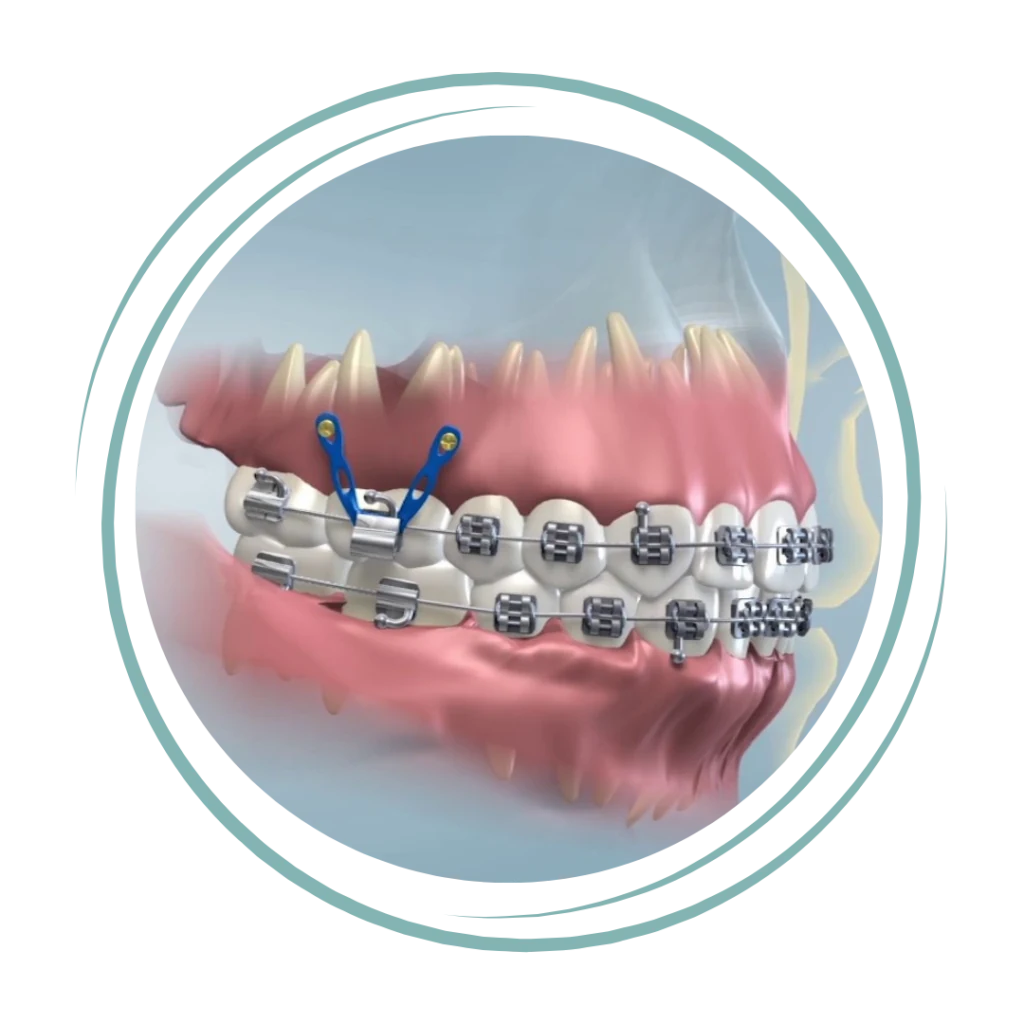
An orthodontic miniscrew is a small anchorage device placed temporarily in bone to provide extra support for certain tooth movements. TADs stands for temporary anchorage devices. When one tooth is moved, the teeth used for support can also move unintentionally; a miniscrew may be planned to help control that reciprocal movement.
This small support, usually made of titanium, serves a different purpose from an implant used to replace a missing tooth. Its role is to support orthodontic movement, and removal is planned when that role is complete. It is not necessary for every patient and does not carry out the whole treatment on its own.
At her clinic in Folkart Towers, Bayraklı, İzmir, Assoc. Prof. Dr. Halise Aydemir assesses the need for a miniscrew alongside the intended movement and suitable alternatives.
A miniscrew may be considered when support from the existing teeth is insufficient for the planned movement, or when keeping the supporting teeth in position is important. The decision depends on which teeth need to move and in which direction, rather than the amount of crowding alone.
Suitability is assessed individually in children, adolescents and adults; age alone does not determine the decision. A miniscrew does not guarantee treatment without extractions or remove the need for jaw surgery. The limits of tooth movement and the skeletal relationship between the jaws need separate assessment. See jaw treatments and orthognathic surgery for this distinction.
A miniscrew is placed under local anaesthesia in a site assessed as suitable. You may feel pressure during the procedure, and tenderness or pain can occur after the anaesthetic wears off. It would be inaccurate to promise the same experience for everyone or a completely painless procedure.
Assessment includes tooth-root positions, bone and soft tissues, oral hygiene and general health information. Imaging is selected according to this assessment; every patient does not need the same set of scans or three-dimensional imaging. The placement site and orthodontic mechanics are individual.
Depending on the planned movement, the miniscrew may be connected to elastics, chains or other orthodontic mechanics. Reviews check both tooth movement and the tissues around the screw. If you are given an elastic to use at home, follow only the instructions demonstrated by your clinician. Pain management and aftercare are also explained individually. The Leicester Hospitals patient leaflet provides further information on local anaesthesia and possible soreness.
Contact the clinic if you notice loosening, increasing pain or a problem around the miniscrew; do not try to solve it yourself while waiting for a routine review. Do not play with the screw with your fingers or tongue, tighten it or attempt to remove it. Your clinician will decide whether a loose screw can still be used, needs removal or requires a revised plan.
Possible problems include loosening, tissue irritation or infection. Depending on the placement site, risks such as contact with a tooth root and screw fracture are also considered. This is why site selection matters and why risks should be explained in relation to your own anatomy.
The British Orthodontic Society miniscrew leaflet describes possible problems and advises against playing with the screw. NHS Fife patient advice also recommends contacting the treating team about miniscrew pain or problems.
Clean around the miniscrew gently and regularly using the method demonstrated by your clinician. At your appointment, ask to practise reaching the area and cleaning around the attached components with a small, soft brush. Avoid manipulating the screw while cleaning.
If a mouthwash or another care product has been recommended, follow your own instructions; the same product is not necessary for everyone. Tell your clinician about tenderness, irritation or a connection problem that makes cleaning difficult. Alongside daily care, regular reviews allow the surrounding tissues and the intended movement to be monitored.
How long a miniscrew stays in place depends on completion of the movement it supports. It may be used for a stage lasting months or as part of a longer plan; there is no removal date that applies to everyone. Removal is planned when its role is complete, and temporary tenderness may follow.
Additional anchorage can make a particular movement easier to control, but this does not guarantee shorter orthodontic treatment overall. Bite goals, the teeth’s response, reviews and other treatment stages affect the total duration. Removing a miniscrew does not necessarily coincide with the end of braces or aligner treatment.
After active treatment, the recommended retention and follow-up plan continues to help maintain tooth positions. Depending on treatment, options may include a clear retainer or a fixed retaining wire. Neglecting this stage can allow teeth to move back and the bite to change. Having used a miniscrew does not remove the need for retention.
Need is assessed by explaining which movement the miniscrew would enable or help control. Anchorage from other teeth, different mechanics or elastics may be alternatives in some plans. These options do not produce the same result for every patient; suitability and limitations are compared during assessment.
You can ask: “Which tooth movement is it for?”, “How would the plan change without it?”, “What alternatives are suitable for me?” and “Who should I contact about care or loosening?” The aim is to understand its role in treatment and your responsibilities, as well as the choice of device.
For an assessment with Assoc. Prof. Dr. Halise Aydemir in İzmir, contact the clinic and explore appointment options. The decision to use a miniscrew follows an individual examination and treatment plan.
Understand root movement, anchorage, space management and bite goals in complex orthodontics, including evidence limits and reasons…
Read the articleLearn how a deep bite differs from protruding teeth, what an orthodontist examines and how braces, aligners and follow-up are…
Read the articleLearn how renewed crowding or spacing after braces is assessed, when a new retainer may help, and how limited or comprehensive…
Read the articleView Assoc. Prof. Dr. Halise Aydemir’s current appointment calendar and choose a suitable day and time.
Prefer to call? +90 530 155 09 52
The calendar is provided in Turkish by DoktorTakvimi. Your booking is completed through DoktorTakvimi. Open the calendar in a separate page
We welcome you to Block A of Folkart Towers for an orthodontic assessment and individual treatment planning.
Adalet Mah. Manas Bulvarı No:47/B, Office 2704