What Happens at Your First Orthodontic Appointment?
Learn about the initial dental and bite assessment, possible records, preliminary versus final planning and the next steps to…
Read the articleAssessment, surgical exposure and controlled orthodontic traction for impacted canines and other impacted teeth in İzmir.
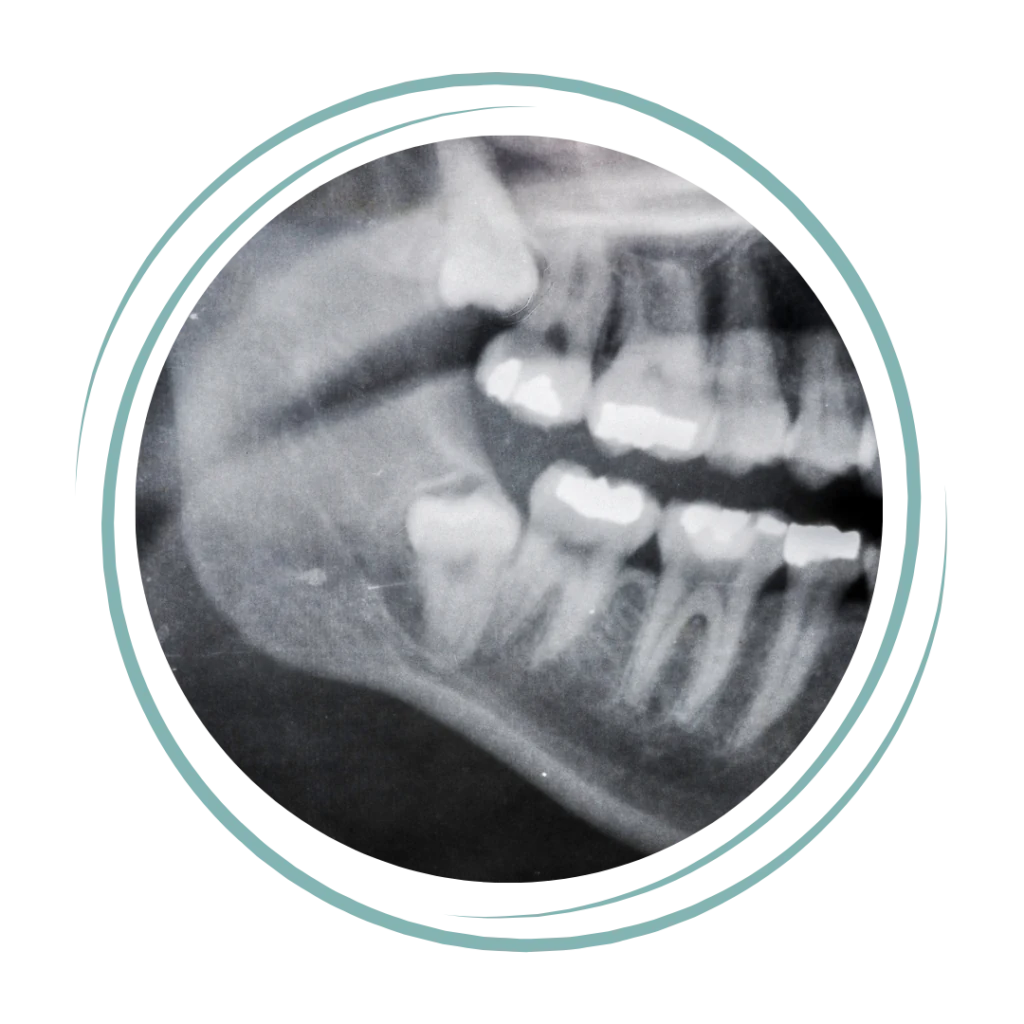
Orthodontic traction aims to bring a tooth that has not reached its expected position into the dental arch in suitable cases. Surgical exposure may be needed to reach the tooth, but uncovering it and moving it into position are different stages. Not every impacted tooth can be treated this way.
For an impacted canine in particular, the decision depends on its position, root, relationship with neighbouring teeth and available space. The aim is not simply to uncover the tooth, but to assess whether it can reach a position compatible with healthy gums and the bite.
At Assoc. Prof. Dr. Halise Aydemir’s clinic in Folkart Towers, Bayraklı, İzmir, orthodontic assessment, space preparation and surgical collaboration where needed are considered within one treatment plan.
A permanent canine that has not appeared at the expected stage, delayed eruption on one side after the other has emerged, or a baby canine remaining for a long time warrants assessment. An unusual bulge in the palate or gum also needs examination. These findings alone do not establish an impacted-tooth diagnosis.
Lack of space, differences in the eruption path, the condition of baby teeth and genetic factors may be associated with impaction. Sometimes an additional condition such as a cyst is investigated; the cause cannot be determined simply by seeing a gap. Upper canines are among the teeth commonly assessed for orthodontic traction.
Absence of pain does not establish that an impacted tooth has a problem-free relationship with neighbouring teeth. Damage to nearby roots or a cyst around the tooth can occur in some cases, but these are not inevitable outcomes. The Hull University Teaching Hospitals patient leaflet explains these possibilities. For general childhood assessment, see preventive orthodontics.
Not every impacted tooth needs extraction, but orthodontic traction is not possible or appropriate for every tooth either. The decision balances tooth preservation against the expected benefit, risks and treatment demands.
Assessment includes depth and inclination, root development, proximity to neighbouring roots, bone and gum health, the bite and space in the arch. Photographs, space analysis and necessary radiographs support planning. Panoramic or periapical imaging may be used; the need for three-dimensional imaging is considered separately. A scan is not automatically necessary for every patient.
Age is one factor in this decision; being an adult does not by itself rule treatment out. A retained baby tooth is also part of the plan and is not assumed to be a permanent solution. The British Orthodontic Society leaflet explains individual comparison of the options.
Surgery provides access to the tooth; orthodontic treatment guides it towards its planned position over time. Completing surgery therefore does not mean that impacted-tooth treatment is finished. The orthodontist and relevant surgeon coordinate the stages.
Force adjustment and chain management remain under clinical supervision. Pulling the connection or attempting to apply more force at home is not part of treatment. The details are explained according to the tooth’s position.
Anaesthesia for surgery is selected according to the procedure and individual circumstances. Pain, tenderness, swelling or bleeding may occur afterwards; the experience is not the same for everyone. Orthodontic adjustments can also cause tenderness. A painless course or identical recovery time cannot be promised.
The surgical team gives individual instructions about cleaning the wound, eating, any stitches or protective material and the review appointment. Use any recommended medicine or care product only according to those instructions. Do not try to adjust an attachment, chain or material covering the wound yourself.
Contact the treating team if a connection breaks or becomes loose, or if you have concerns about healing. Your postoperative information helps distinguish expected recovery from a problem needing review. Daily oral care and continued appointments support monitoring of gum health.
Duration depends on tooth position, movement distance, the relationship with neighbouring teeth and tissue response. Time until the tooth starts to appear differs from the duration of the whole orthodontic treatment. Traction can take months, and overall treatment can be longer in complex cases. A definite completion date cannot be given without assessment.
Sometimes fusion of the tooth to bone, called ankylosis, can prevent movement. The plan is then reassessed rather than simply increasing force; removal and alternative options may be considered. A decision to attempt traction does not guarantee the outcome. This possibility should be discussed before treatment.
Once the tooth is aligned, follow-up considers more than appearance: gum level, supporting tissues and participation in the bite are also monitored. An individual clear retainer or fixed retaining wire and reviews may be planned after active treatment. Neglecting retention can allow teeth to move back and the bite to change. The tooth becoming visible does not remove the need for follow-up.
Questions such as “Is the tooth’s position suitable for traction?”, “Is there a risk to neighbouring roots?”, “Who will plan the surgical stage?”, “What are the alternatives if it does not move?” and “Which stages does the time estimate cover?” help you understand treatment. You can also discuss daily care, review frequency and retention responsibilities.
For an assessment with Assoc. Prof. Dr. Halise Aydemir in Bayraklı, İzmir, contact the clinic. Sharing previous imaging and treatment records, if available, helps bring existing information together; the need for new investigations is determined during assessment.
Learn about the initial dental and bite assessment, possible records, preliminary versus final planning and the next steps to…
Read the articleLearn why crooked eruption needs an individual space and development assessment, when to seek advice, and how planned monitoring…
Read the articleWhen is orthodontic treatment required in children? Learn about dentition periods, monitoring, early intervention, devices and…
Read the articleView Assoc. Prof. Dr. Halise Aydemir’s current appointment calendar and choose a suitable day and time.
Prefer to call? +90 530 155 09 52
The calendar is provided in Turkish by DoktorTakvimi. Your booking is completed through DoktorTakvimi. Open the calendar in a separate page
We welcome you to Block A of Folkart Towers for an orthodontic assessment and individual treatment planning.
Adalet Mah. Manas Bulvarı No:47/B, Office 2704