Does a prominent lower jaw always require surgery?
Understand dental, functional and skeletal causes, childhood treatment, adult camouflage and when surgical assessment is considered.
Read the articleOrthodontic assessment of crowding, Class II and Class III bite problems, jaw relationships and facial balance for children and adults in İzmir.
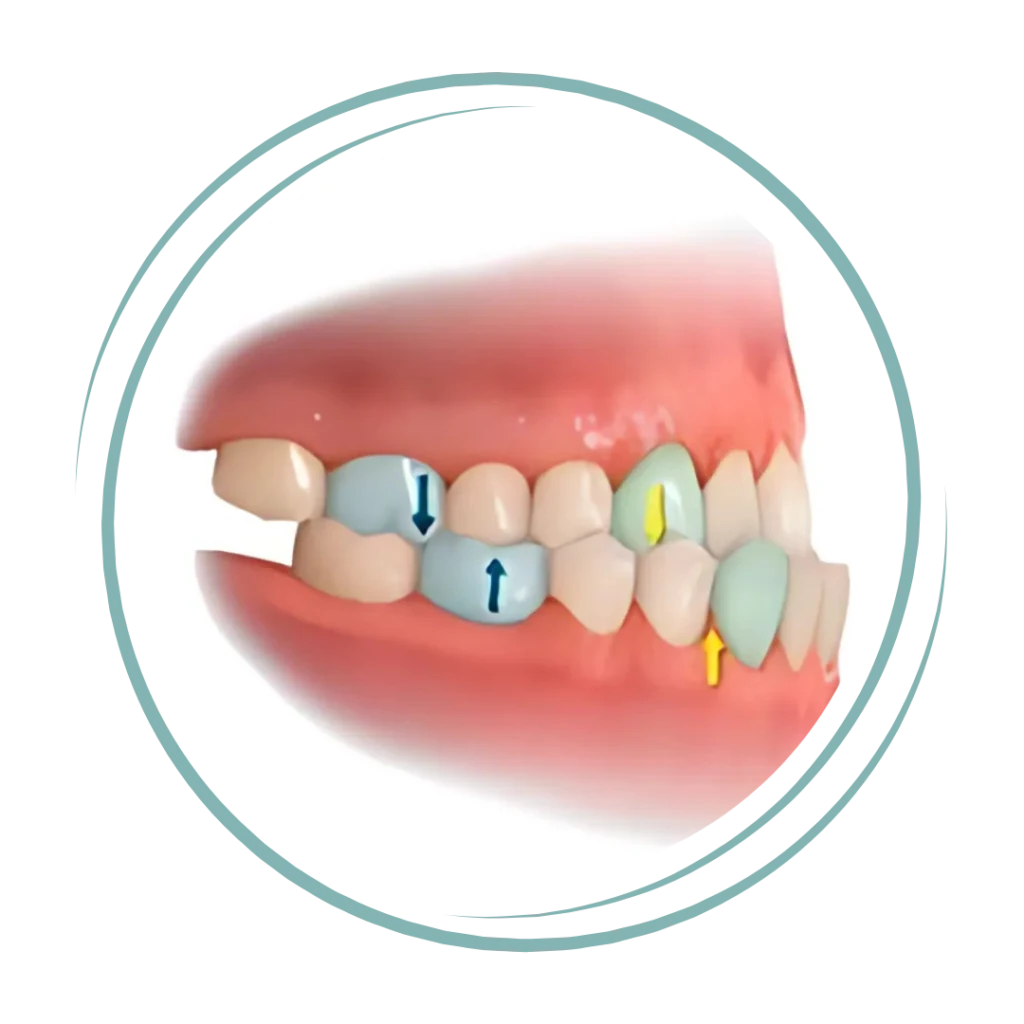
Malocclusion is a discrepancy in tooth alignment or the relationship between upper and lower teeth when biting. Class I, II and III describe different relationships, rather than stages progressing from mild to severe. Suitable treatment depends on positions, jaw relationships, growth, oral health and personal goals, not the class name alone.
At Assoc. Prof. Dr. Halise Aydemir’s clinic in Folkart Towers, Bayraklı, İzmir, children, teenagers and adults are assessed with these findings together. Beyond straight front teeth, the aim is to explain which bite or appearance change is intended for you and its limits.
These classes help describe front-to-back relationships between upper and lower teeth. Dental bite class and jawbone position are different information. Class II does not alone prove lower jaw retrusion, and Class III does not always establish excessive lower jaw growth.
| Class | General description | What it cannot establish alone |
|---|---|---|
| Class I / Class 1 | The front-to-back dental relationship may be relatively harmonious despite crowding, rotations or spacing. | That all alignment and bite relationships are problem-free. |
| Class II / Class 2 | Lower teeth have a more rearward relationship to upper teeth. | That only the lower jaw contributes, or that all patients have the same front tooth appearance. |
| Class III / Class 3 | Lower teeth have a more forward relationship; reverse front tooth contacts may accompany it. | That surgery is mandatory or the lower jawbone is the sole cause. |
AAPD developing dentition guidance distinguishes dental, skeletal and, in some cases, functional components in Class II and III relationships. Ask which components apply to you rather than choosing a diagnosis or treatment from the table.
The class number is not a severity score. Class I does not progress through Class II into Class III. Patients within the same class can have different bites, oral health and treatment needs.
Crowding, spacing, prominent upper teeth, lower teeth biting ahead of upper teeth, difficulty biting or uncomfortable lip closure can prompt assessment. Appearance alone cannot identify dental versus jaw-related causes. Absence of pain does not establish that every relationship is appropriate.
Deep bite, open bite and crossbite are not alternative names for Class I–II–III. They describe vertical overlap, contacts or inner-outer relationships and can coexist with a class. The AAO bite problems guide discusses these appearances separately.
Crowding can also make some areas harder to clean; describe this and any gum symptoms. Report chewing, speech, joint pain or other symptoms separately. Do not assume the bite is their sole cause or that orthodontics will certainly resolve them.
Assessment timing and active treatment timing differ. A bite discrepancy, reverse front contacts or closure shift can be assessed before all permanent teeth erupt. Examination considers tooth replacement, growth and current function. Not every child immediately needs the same appliance.
Suitable treatment during growth may improve some relationships, without guaranteeing control of all growth or avoidance of later surgery. Families should understand current goals and what remains under review. See child orthodontic assessment for the wider framework.
Adulthood alone does not mean treatment is too late. Gum and bone support, missing teeth, restorations and required movements are assessed. The same device cannot be expected to have identical effects in growing children and adults; the adult orthodontics guide explains this difference.
First discuss your concern, its duration and previous care. Alignment, upper-lower contacts, jaws, facial profile and oral health are then examined together. Forward or sideways movement during closure is assessed separately from fixed tooth positions.
Photographs, impressions or scans and necessary radiographs answer particular questions. Not everyone needs an identical imaging package. The first appointment guide explains their purposes.
Do not leave with only a Class II or Class III label. Clarify these distinctions:
Class alone cannot select a method. Fixed brackets and clear aligners may control tooth movement. Suitable functional or expansion appliances in growing patients, temporary anchorage for some movements or joint surgical assessment for substantial skeletal differences may be considered. Methods are not equivalent for every goal.
For example, compensating through adult tooth movement differs from repositioning jawbones. For nonsurgical plans, ask which differences may remain; for surgical assessment, ask which goal movement alone cannot address. Read surgical decisions for a prominent lower jaw and orthognathic suitability for these limits.
Space needs, supporting tissues and existing teeth also affect crowding plans. Class II does not automatically require extraction or establish that non-extraction care is always possible. Extraction decisions in orthodontics require separate assessment.
After goals and methods are explained, discuss estimates, reviews and additional stages. Do not calculate duration from a class number or another person's experience. Understand which need the plan addresses.
Review considers more than straight front teeth. Original contact and bite goals, and any functional symptoms, are reassessed. Knowing which findings will be compared avoids judging the whole treatment by one photograph.
Retention helps reduce the risk of tooth movement after treatment. Fixed or removable retainers and reviews are explained individually; results are not automatically permanent for everyone. See the retainer guide for device purposes. Report changes in fit or bite rather than adjusting appliances yourself.
Share appearance or functional concerns, when first noticed and previous orthodontics. Understand your goals alongside the class label:
For assessment at Assoc. Prof. Dr. Halise Aydemir’s clinic in Folkart Towers, Bayraklı, see appointment information or call +90 530 155 09 52. Suitable options depend on individual examination, not classification alone.
View Assoc. Prof. Dr. Halise Aydemir’s current appointment calendar and choose a suitable day and time.
Prefer to call? +90 530 155 09 52
The calendar is provided in Turkish by DoktorTakvimi. Your booking is completed through DoktorTakvimi. Open the calendar in a separate page
We welcome you to Block A of Folkart Towers for an orthodontic assessment and individual treatment planning.
Adalet Mah. Manas Bulvarı No:47/B, Office 2704